GoG2G - Go Green to Green
Analyzing Socially Responsible Stocks and the Future of Alternative Fuels
G2G

Sugar Shoots Up as Brazil Will Benefit

The world's most heavily traded sugar futures contract, Sugar No. 11 on the ICE, rose Tuesday 4.6% to 13.72 cents per pound after UNICA reported that Brazil will use more sugarcane than expected for ethanol production as crude oil continues its push into uncharted territory. This is the highest Sugar No. 11 has been in nearly four months. UNICA reported that ethanol consumption in Brazil has risen 54.8% between January and May as, "in recent weeks, in 92% of the Brazilian market, ethanol from the pump recorded prices 65% lower than a liter of gasoline." With this newly created demand, and what is expected to be a rainy next month, Brazil's sugar prices are bound to rise. This is not a bad thing, though, as the current price for sugar in Brazil is very low. As Carlos Murilo Barros de Mello of Cosan puts it, "the world will need more cane, the most competitive country is Brazil, so prices will have to rise to boost investment in new mills."

Ethanol Producers in Trouble as Corn Sets New Record

Add "bad weather" to the already lengthy list of problems corn-ethanol needs to overcome. Heavy rains, severe winds, and tornadoes throughout the Midwest has propelled corn into uncharted territory. July corn on the CBOT rose 28.6 cents Thursday to settle at an all time high of $6.43 1/4 a bushel.

Farmers are saying this is the worst weather they have seen since 1993, when U.S. crops suffered from weeks of rain that eventually led to the severe flooding of the Mississippi river. Agriculture Secretary Ed Shafer expressed "a lot of concern" for the corn crop in Thursday's summit on the global food crisis.

The option of replanting corn that was damaged in May is dwindling as farmers are deciding whether they should replace their corn with a shorter growing season crop like soybeans. All ethanol producers can do now is desperately pray for sunshine as there is already a tight supply of corn available.

Assisting Thursday's massive jump was a ~ $6 rise in crude oil as the dollar lost ground against the Euro.

Corn Jumps on Weather/Oil/Yen

July corn on the CBOT rose 16.4 cents today to settle at $6.15 a bushel.

The Reasoning:

- A "wet May" in the corn belt has taken a substantial toll on the crop. In the first crop progress report of the year, the USDA revealed that only 63 percent of the corn crop is in good to excellent condition, compared with 78 percent a year ago. More farmers than usual are currently deciding whether they should replant the corn that has been damaged or replace it with a shorter growing season crop like soybeans. In Illinois, for example, farmers typically have to replant about 1 to 2 percent of the corn acreage. Emerson Nafziger, extension agronomist at the University of Illinois, though, won't be surprised if this number jumps to 4 to 5 percent for this years crop.

- Oil rose 41 cents to close at $127.26 a barrel as U.S. factory data was stronger than expected.

- The yen had its biggest gain against the dollar in nine weeks as Japan is a major consumer of U.S. corn.

McCain Slams Corn-Ethanol/Obama Follows

John McCain and twenty-three other Republican Senators sent a letter last Friday to the EPA asking the agency to reevaluate the current ethanol mandate as food prices continue to soar. The EPA does have the authority to waive the mandate or structure it differently "if the mandate results in adverse unintended effects."

In the letter, McCain stated:

“Every time hardworking American families buy groceries, they feel the financial sting of misguided federal policies mandating that taxpayers support ethanol. It isn’t a surprise that food prices are rising when more than 25 percent of the corn grown today is taken out of the food supply and instead used for subsidized ethanol production. This subsidized program - paid for with taxpayer dollars - has contributed to pain at the cash register, at the dining room table, and a devastating food crisis throughout the world. We need to put an end to flawed government policies that distort the markets, raise food prices artificially, and pit producers against consumers. We must call on the EPA to exercise its authority to not exacerbate this already bad situation.”

Obama, two days later, on "Meet the Press" stated that, "there's no doubt that biofuels may be contributing to [rising food prices]."

With the growing political concern over ethanol,  May corn on the CBOT fell 20 cents today to $5.82 per bushel.

In today's trading, VeraSun slipped 9.61% to $6.21 a share while Aventine dropped 7.73% to $5.01 a share.

Without government intervention, ethanol will become a fad real quick.

U.S. Ethanol Investors: Beware of Brazil

Rumor has it that Brazil's ethanol producers are getting ready to invade the U.S. market. Many will be willing to swallow the 54-cent tariff (which is expected to expire in 2009) imposed on their ethanol. Joao Val, CFO of Sao Martinho SA, one of Brazil's leading ethanol producers, believes "Brazil is going to be much more aggressive this summer to sell ethanol...in the U.S."

With U.S. corn ethanol currently selling at a high price of $2.48 per gallon, many Brazilian companies see a lucrative opportunity in exporting their cheap sugar-cane based alternative. Even with the tariff included, Americans currently get to purchase Brazilian ethanol at a bargain price of around $2.18 a gallon. This number is bound to go even lower with Brazil harvesting a record-breaking sugarcane crop of over 500 million metric tons.

This only spells trouble for the U.S.'s nascent ethanol industry as U.S. producers are already struggling with high corn prices. Currently hovering around $6 a bushel, corn prices are expected to go even higher as the USDA recently announced an 8% expected drop in U.S. corn plantings.

As a result, several ethanol producers have already suspended production or even filed for bankruptcy such as Kansas based Ethanex Energy. New Zealand's LanzaFuels announced late last year its plans to put local ethanol production on hold due to cheaper imports from Brazil. Brazil's cheap prices will only make it harder for these companies to grow.

Brazil will be especially eager to sell to the U.S. with recent developments in the European market. Brazil's hold on this market has become increasingly tenuous as Germany has decided to postpone its plans to introduce a mandatory 10% ethanol mix in gasoline and the UK has decided to do away with the credit line for its E85 program. With more focus put on the U.S. market, Brazil may be successfully maneuvering a checkmate to an already beaten down U.S. ethanol industry.

Corn Hits $6

Ever since the USDA projected US corn acreage to decrease by 8% this year, corn prices have shot up nearly 35 cents to $6.00 per bushel. Rainy weather moving across the Midwest has also contributed to the current rally as early plantings in the southern belt could be delayed. Ethanol prices, however, have not kept pace as ethanol's crush spread has fallen 33 cents since last Friday to settle at $1.02. Weather will be key for corn in the coming weeks.


The Price VeraSun Pays for Corn

Let's see how VeraSun faired with its first quarter corn costs:

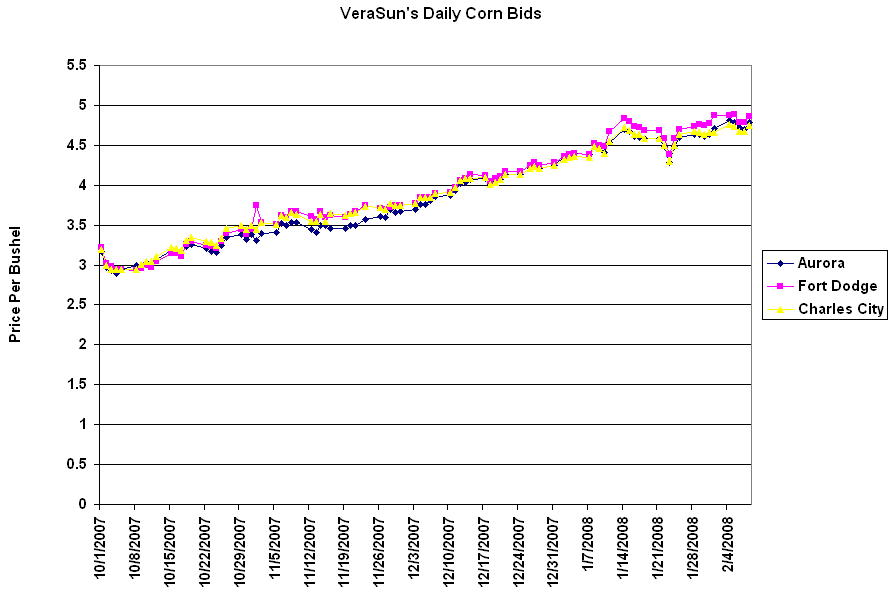
VeraSun's Daily Corn Bids for 1Q2008

The average price from January 2nd to March 31st for VeraSun's three plants - Aurora (120), Fort Dodge (110), and Charles City (110) - was a horrific $4.84 per bushel. The Linden (110) and Albion (110) plants are not accounted for as their daily corn bids are not available. In its previous quarters, VeraSun has paid an average of $3.61 per bushel (fourth), $3.32 per bushel (third), $3.62 per bushel (second), and $4.05 per bushel (first).

If this isn't bad enough, the USDA stated today that farmers are expected to plant 86 million acres of corn this year, down 8% from 93.6 million in 2007. The cut in supply only means that corn prices will go even higher. May corn on the CBOT jumped 6.6 cents today to $5.67 per bushel.

Just another bad day in the ethanol industry!

Pacific Ethanol Anticipates a Gloomy Fourth Quarter

Today's biggest stories surrounding the sector:

After its largest one-day gain in nearly four months, Pacific Ethanol disturbed investors by releasing its anticipated fourth quarter earnings.

What did the report say?

-"The Company anticipates reporting gross profit of approximately $1.7 million for the fourth quarter of 2007 as compared to gross profit of $11.7 million for the same period in 2006. The Company anticipates reporting that its gross profit margin was approximately 1.3% for the fourth quarter of 2007 as compared to a gross profit margin of 14.6% for the same period in 2006. The decline in the Company's gross profit and gross profit margins was primarily due to a lower average sales price of ethanol and significantly higher corn costs." Although Pacific Ethanol sold its ethanol for an average of only $1.97 per gallon, it did manage, at least, to out price both VeraSun ($1.87) and Aventine ($1.94). The price PEIX paid for its corn, however, is not mentioned.

-"The Company anticipates reporting a net loss of approximately $14.7 million for the fourth quarter of 2007 as compared to a net loss of $3.1 million for the same period in 2006."

-"The Company anticipates reporting a diluted net loss per common share of approximately $0.39 for the fourth quarter of 2007 as compared to a net loss per common share of $0.11 for the same period in 2006." The average analyst estimate is $-0.13. Yikes!

- Here is one thing to be optimistic about:
"The Company anticipates reporting net sales of approximately $130.4 million for the fourth quarter of 2007 as compared to net sales of $80.6 million for the same period in 2006. The volume of ethanol sold by the Company in the fourth quarter of 2007 increased by approximately 82% as compared to the same period in 2006 and by approximately 16% as compared to the third quarter of 2007." It seems that Pacific Ethanol will beat the average analyst estimate of 122 million.

Pacific Ethanol's official fourth quarter earnings will be released on March 31st. Stay away from PEIX and any other pure-play ethanol company until profit margins improve as ethanol's crush spread is still very weak. Can the spring and summer travel season cause ethanol's demand to spike?

Corn Falls Limit-Down

Today's biggest stories surrounding the sector:

-
May corn fell 20 cents today to $5.39 1/4 per bushel due to oil's steep decline. Oil slid $4.53 to $105.88 per barrel as the sale of Bear Stearns added fear to the current credit crisis. Ethanol's crush spread, however, fell also as April ethanol dropped 10.2 cents to $2.36 per gallon.

Ethanol Stocks Continue to Fall Fast

Today's biggest stories surrounding the sector:

-Ethanol stocks plummeted today due to yesterdays news of corn shooting up 14 cents and Bush finally showing concern over corn-ethanol. VeraSun(9.03%) and Aventine(12.02%) hit new 52-week lows while Pacific Ethanol(10.90%) neared its own of $4.20 a share. Assisting the downfall was a report published today by the Wall Street Transcript which set a bleak outlook for ethanol this year. In the report, Pavel Molchanov of Raymond James & Associates stated "a typical ethanol producer will be at best breaking even this year and possibly losing money on the bottom line" due to what has been a persistent margin squeeze. March corn managed to stay unchanged today.

Ethanol's Crush Spread Plunges/Bush Praises Ethanol Yet Shows Concern

Today's biggest stories surrounding the sector:

- The combination of March corn climbing 14 cents and March ethanol falling 4.6 cents caused ethanol's crush spread to drop 27 cents today to $1.02. Corn prices shot up as a result of oil's $5 run.

- Investors will be pleased to hear that President Bush renewed his support for ethanol today at the Washington International Renewable Energy Conference. Below is what he had to say:

"The vast majority of [our] ethanol is coming from corn, and that's good. That's good if you're a corn-grower. And it's good if you're worried about national security...Corn ethanol holds a lot of promise, but there's a lot of challenges. If you're a hog-raiser in the United States, you're beginning to worry about the cost of corn to feed your animals. I'm beginning to hear complaints from our cattlemen about the high price of corn. The high price of corn is beginning to affect the price of food...I look forward to the day when people in the parts of our country that have got a lot of forests are able to convert wood chips into fuel...The job of the federal government is to expedite [this] arrival."

Wow! Bush is finally expressing concern over corn-ethanol. That took him a while.

Ethanol Stocks Dive/Cellulosic Ethanol is Behind Schedule

Today's biggest stories surrounding the sector:

-News of corn reaching an all-time high caused pure-play ethanol stocks to tumble today. VeraSun was the biggest loser as it dropped $1.18(13.21%) to a 52-week low of $7.75 a share. On the CBOT, March corn retreated 12.4 cents to $5.43 per bushel (on profit-taking) while March ethanol dropped only .001 cent to $2.400 per gallon.

-Guy Caruso, the head of the EIA, stated today that "quantities of cellulosic ethanol prior to 2022 will be insufficient" to meet the 36 billion gallon requirement as there has yet to be an efficient way of production. Cellulosic ethanol is responsible for contributing nearly half of the mandate. Caruso estimates that only 32.5 billion gallons will be reached by the target date. Good news, though, is that the USDA and DOE announced today that they will invest up to $18.4 million in several projects aimed at improving the process. It is important that we get such funding as Ethanol will not last if we cannot produce it cellulosically.

Corn Continues Bullish Push

Today's biggest stories surrounding the sector:

- Corn continued its push into uncharted territory today as March corn on the CBOT settled 9.4 cents higher to $5.55 per bushel. The rise was due to spillover support from soybeans, crude oil, silver and gold. The cost for corn has recently become a much greater problem for ethanol producers as VeraSun - at its Aurora plant - bought its corn today for a frightening $5.33 per bushel. Ethanol futures, however, managed to overshadow the record-setting gain by climbing 4.1 cents to $2.401 per gallon (Remember: 1 gallon of ethanol = 2.8 bushels of corn).

Corn Skyrockets/Verenium Wins Grant

Today's biggest stories surrounding the sector:

- March Corn shot up 18 1/4 cents today to $5.43 1/4 per bushel. The rise was due to a record setting rally by both gold($975 per ounce) and oil($102.59 per barrel) as the U.S. dollar fell to a record low against the Euro. Ethanol on the CBOT managed to rise 3.9 cents to $2.359 per gallon. After today's trading, ethanol's crush spread has fallen to $1.17.

Date
CBOT ethanol price
CBOT corn price
Crush spread
February 28th
 $2.36
 $5.43
 $1.17
January 2nd
 $2.42
 $4.62
 $2.15
December 18th
 $2.13
 $4.32
 $1.66
December 15th
 $2.08  $4.38
 $1.44
November 19th
 $1.81 $3.94  $1.12
October 16th
 $1.61 $3.74 $.77
September 1st
 $1.54  $3.69  $.62

-Verenium Corporation (VRNM) was awarded today one of the four grants available by the U.S. Department of Energy to "develop improved enzyme systems to convert cellulosic material into sugars suitable for the production of ethanol." Verenium will receive a nice slice of the $33.8 million available. Earlier in the year, Pacific Ethanol received a similar grant of up to $24.3 million to build a small-scale demonstration plant that will make ethanol out of wood chips.

Taxing Big Oil/Ethanol Fires/Cargill Suspending Operations

Here are today's biggest stories surrounding the sector:

-The House approved an $18 billion tax package today that would repeal a tax break for the country's five largest oil companies. The money, which would be collected over 10 years, would be used to provide tax breaks for alternative energy sources such as wind, solar, and cellulosic ethanol. President Bush, though, is expected to veto the bill if it passes Congress. This is odd considering Bush was the one who stated two years ago - when oil was at $55 a barrel - that oil companies no longer need government subsidies. With oil currently hovering around $100 a barrel and oil companies reporting record profits, why is Bush threatening to veto? Republicans are worried the new tax "would inhibit investments in domestic oil and gas exploration and production." Oh, Please!

-Another problem has been added to ethanol's list: Ethanol fires are harder to put out than gasoline ones as water cannot be used and a special type of firefighting foam is required. This is a foam that many fire departments in the country don't have and is 30% more expensive than the conventional foam used for gasoline fires.

- Cargill announced today that it will suspend construction on its 100 million-gallon-per-year ethanol plant in Kansas due to high corn prices.

Ethanol-Pipelines Soon to Come?

A significant problem with ethanol is that it corrodes current pipelines due to its solubility in water. This makes it difficult to transport the fuel long distances as this is a hurdle the industry desperately needs to overcome. Good news, though, is that Magellan Midstream Partners - a company that pipes gasoline - is planning on constructing a $3 billion ethanol pipeline. "The line would bring ethanol from production facilities in Iowa, Illinois, Minnesota and South Dakota to terminals in Pittsburgh, Philadelphia and the New York harbor." If done, this would greatly benefit the net energy of ethanol as the current use of trucks and trains for transportation are inefficient - both economically and environmentally. Coincidentally, Brazil's Petrobras today announced that it plans on building the world's first ethanol-only pipeline. Petrobras says the "pipeline will carry ethanol that is mainly destined for exports to countries such as Japan."

The Price VeraSun Pays For Its Corn

Below are the daily prices VeraSun (VSE) paid for its fourth-quarter corn and beyond. The average price from October 1st to December 31st for VeraSun's three plants - Aurora (120), Fort Dodge (110), and Charles City (110) - was $3.58 per bushel. The Linden (110) and Albion (110) plants are not accounted for as their daily corn bids are not available. In the new year, VeraSun's average corn bid has horrifically risen to $4.60 per bushel. In its previous quarters, VeraSun has paid an average of $3.32 (third), $3.62 (second), and $4.05 (first).


Ethanol Doesn't Get Usual Attention in State of the Union Address

In his 2005 State of the Union Address, President Bush stated that there is "strong funding for...ethanol." In his 2006 Address, he revealed his plan to make ethanol "practical and competitive within six years" after he famously stated "America is addicted to oil." It was this announcement that established ethanol as an alternative energy powerhouse as ethanol stocks immediately bubbled to new highs. In his 2007 Address, Bush announced that "we must continue investing in new methods of producing ethanol, using everything from wood chips to grasses, to agricultural wastes" in hope of "reducing gasoline usage in the United States by 20 percent in the next 10 years." This year, however, President Bush didn't specifically acknowledge ethanol in his State of the Union Address; the first time since 2004. In his shorter-than-usual monologue on the environment, he simply reiterated what we had already heard in his previous addresses. Overall, his speech lacked any major change in our energy policy. Ethanol investors should not expect a big boost from Bush's address.

The President did manage, however, to propose a $2 billion fund that would be disbursed over the next three years to help developing nations purchase alternative energy technologies. This is a small amount, however, considering China alone is investing over $100 billion a year on alternatives such as coal-fired electricity.

Ethanol Stocks Up Big Before State of the Union Address

Ethanol stocks were fueled today by speculation that George Bush will once again emphasize the fuel in his State of the Union Address. Pacific Ethanol, currently up 6.03% in after hours,  led the sector with a gain of 5.22% to $5.64 a share. Let's see what the President has to say...

Oil's True Energy Balance

Following Dr. Pimentel’s detailed calculations in finding the ERoEI of ethanol, I would like to suggest a similarly rigorous analysis of the ERoEI of oil. As oil becomes scarcer, both the direct cost of extraction and the indirect cost of defending and securing the geographical areas that are oil abundant increases.  Here I will argue that the current calculation of oil’s ERoEI grossly overestimates its true net energy balance.  

Dr. Pimentel estimates the current ERoEI of corn-ethanol as 0.8.  In comparison, current calculations of the ERoEI of oil reveal an impressive ratio of 3:1.  Of course, this number is miniscule in comparison to the 1940’s when only 1 barrel of oil was required to extract 50 – 100 barrels of oil.   The reason for the gradual decrease in oil’s ERoEI has been the increasing amount of energy needed to be used to extract an increasingly scarce natural resource.  However these calculations only take into account the technology and manpower directly required to discover, mine, process, and transport oil.   They do not take into account the costs incurred in securing and defending access to oil fields that are becoming more and more highly contested.  

Though this is controversial, today much of the US’s foreign policy initiative is directed towards securing our oil interests in the Middle East. The government expenses on just the Iraq war have exceeded over 400 billion dollars. In addition, Linda Bilmes of Harvard University, states that if the war continues for another 5 years the total cost will amount to 1.4 trillion dollars. Though it is debatable how much of this money is directly used to secure oil interests, should we include this entire amount in the calculations of the ERoEI of oil? Should we include the 82 billion dollars spent on the first gulf war defending the oil fields in Kuwait?   In addition, China is emerging as a major oil consumer and military superpower.  Could the future bring us a major direct or indirect conflict with China over oil?  Should we take the costs of such a conflict into account when discussing energy alternatives?

Dr. Pimentel has provided us with a very in depth analysis of the energy balance associated with the production and transport of ethanol.   Estimation of the true cost of oil may benefit from a similarly in depth analysis that takes into account the political and military costs of our addiction.